

Mixed-use development is a targeted strategy for real estate investors, yet its economic benefits have remained difficult to quantify.
An analysis of more than 74,000 office, retail, and multifamily properties across 49 major US metropolitan areas finds that mixed-use environments generate significant rent premiums, with the greatest observed benefits occurring where complementary uses create true ecosystem effects.
Key findings include:
- Mixed-use environments command meaningful rent premiums across office, retail, and multifamily properties.
- Rent premiums persist even after controlling for market and submarket differences, suggesting a genuine mixed-use environment effect.
- The strongest premiums occur in suburban locations, where mixed-use remains relatively scarce and therefore more differentiated.
- Successful mixed-use is driven not simply by combining uses, but by thoughtfully curating the right mix of residential, office, retail, and public spaces to create complementary demand and support potential long-term value.
THE MIXED-USE ENVIRONMENT
For much of modern real estate history, investors have evaluated buildings as individual assets. Apartment communities were underwritten on rents, occupancy, and operating expenses. Office buildings were valued on leasing activity and tenant credit. Retail centers were judged by foot traffic and sales productivity. Even when properties sat next to one another, they were typically analyzed in isolation, as though each operated alone.
That is not how consumers, residents, tenants, and employers actually experience real estate.
A resident choosing where to live may spend as much time weighing nearby restaurants, parks, and job options as evaluating the apartment itself. Employers compete for talent by locating where the surrounding environment offers more than a desk. Retailers seek a built-in customer base of nearby residents and office workers. Hotels may also benefit from proximity to all three. The value of a property, in other words, is increasingly shaped by the quality of the environment around it. The more difficult question is whether it independently contributes to stronger real estate performance.
Answering that question is far from straightforward. Properties located in mixed-use environments also tend to benefit from stronger demographics, better accessibility, newer construction, and more desirable neighborhoods, making it difficult to distinguish correlation from causation. Consequently, much of the discussion around mixed-use has focused on qualitative benefits such as placemaking, vibrancy, and experience rather than quantifying the economic value created by the surrounding environment.
To address this challenge, we analyzed more than 74,000 office, retail, and multifamily properties across 49 major US metropolitan areas. The results indicate that mixed-use environments generate measurable rent premiums and suggest that much of this value may arise from the interaction of complementary uses rather than the characteristics of any individual building.
DEFINING MIXED-USE: PROJECTS VS. ENVIRONMENTS
One challenge in studying mixed-use is that the term lacks a consistent definition, and it is applied to two genuinely different things. A mixed-use project is a specific development that combines multiple uses on a single site, such as an apartment tower over ground-floor retail, a hotel attached to an office building, or a master-planned campus.
A mixed-use environment is something broader: a geographic area where residential, retail, office, and public uses coexist in meaningful concentration, regardless of whether any individual building is itself mixed-use. A neighborhood can function as a mixed-use environment even if most of its buildings remain single-purpose.
The distinction matters because much of the value associated with mixed-use appears to arise from the ecosystem rather than from any single building. The benefits appear to be generated through interaction: residents support nearby retailers; retail can make the residential setting more attractive; office tenants gain access to amenities, services, and labor; hospitality feeds on the activity all of the above create. The resulting web of relationships produces value that would not exist if each use stood alone. This paper attempts to measure the environment effect, not the project effect.
QUANTIFYING THE MIXED-USE PREMIUM
Despite mixed-use’s popularity, the industry has struggled to measure its impact. The major commercial real estate databases do not systematically classify mixed-use environments. As a result, most prior research leans on single-market case studies or substitutes walkability scores as a proxy, which blurs the line between mixed-use and density, transit access, and broader urbanity.
To address this, we built a spatial classification from the ground up across 49 major US metropolitan areas, covering office, retail, and multifamily assets. Rather than relying on labels, we measured the concentration and diversity of uses surrounding each property:
- Buffer-based identification: Using each retail property as a node, we drew a 500-meter radius and counted the office, retail, and multifamily properties within it.
- Shannon Diversity Index: We classified an area as mixed-use only when all three property types were present, the Shannon entropy exceeded 0.8 (indicating balanced diversity rather than dominance by one type), there were a minimum of at least ten properties, and at least two properties of each type were present.[i]
- A stringent screen: Of the 44,374 retail-anchored buffers tested, only 5% (2,083) cleared all four thresholds. The vast majority of retail locations do not qualify as genuine mixed-use anchors.
- Within-market comparison: Mixed-use environments cluster in higher-cost markets such as New York, San Francisco, and Boston. Comparing rents across markets would simply capture this “expensive city” effect, so we compared mixed-use to non-mixed-use rents within the same metropolitan area, then took a property-count-weighted average of those market-level premiums.
As a robustness check, we repeated the entire analysis at the CoStar submarket level. The resulting dataset of roughly 74,600 properties makes this one of the largest studies of mixed-use environments conducted to date.
The results were both consistent and economically significant. Across all three major property types, properties inside mixed-use environments achieved higher rents than comparable properties elsewhere in the same market, with statistical significance well beyond conventional thresholds.[ii]
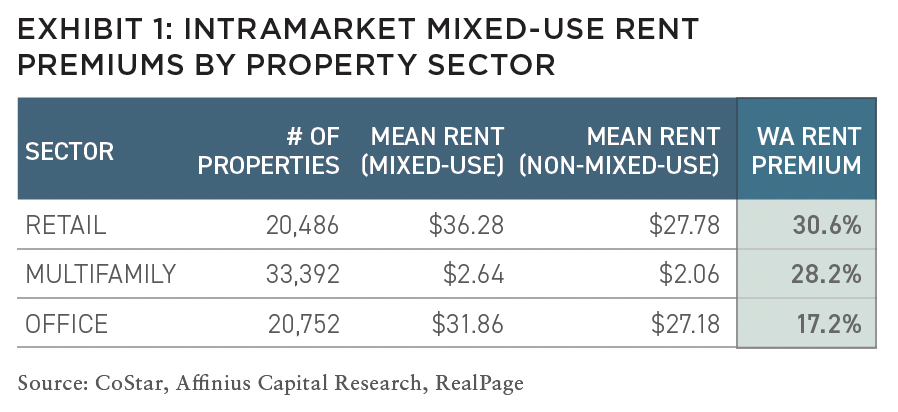
Across all three major property types, properties located within mixed-use environments achieved higher rents than comparable properties elsewhere within the same market, as shown in Exhibit 1.
Retail properties generated the largest premium, with rents averaging approximately 31% higher than retail properties located outside mixed-use environments. Multifamily properties exhibited a premium of approximately 28%, while office properties generated a premium of roughly 17%.
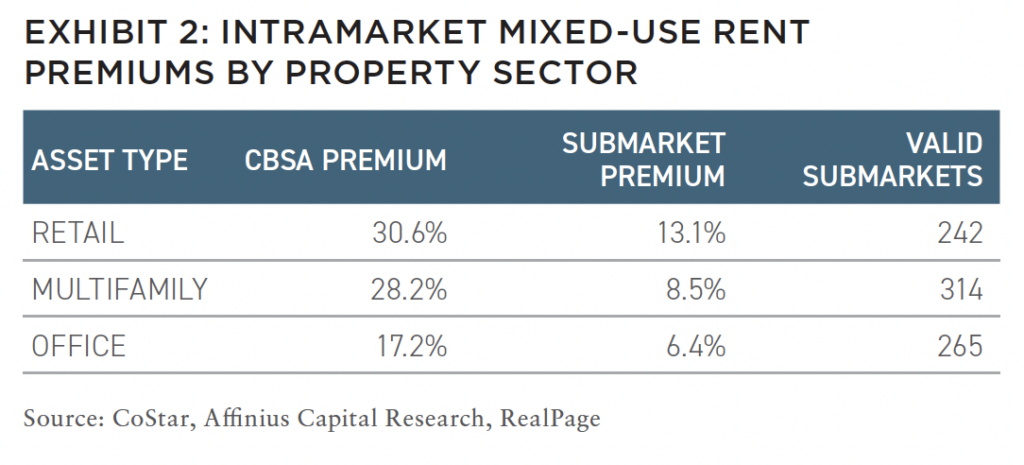
Because mixed-use areas could be concentrated in higher-rent submarkets within each metro, we re-ran the comparison at the submarket level.
The premiums narrow, as expected, since tighter geographic controls strip out more variation. However, the premiums persist, as shown in Exhibit 2, which suggests we are measuring a genuine environment effect rather than simply a “better neighborhood” proxy.
NOT JUST A DOWNTOWN STORY
Perhaps the most surprising finding concerns where these premiums occur. Mixed-use is usually associated with downtown districts and dense urban cores; the prevailing assumption is that mixed-use environments are more or less synonymous with CBDs. Our data says otherwise.
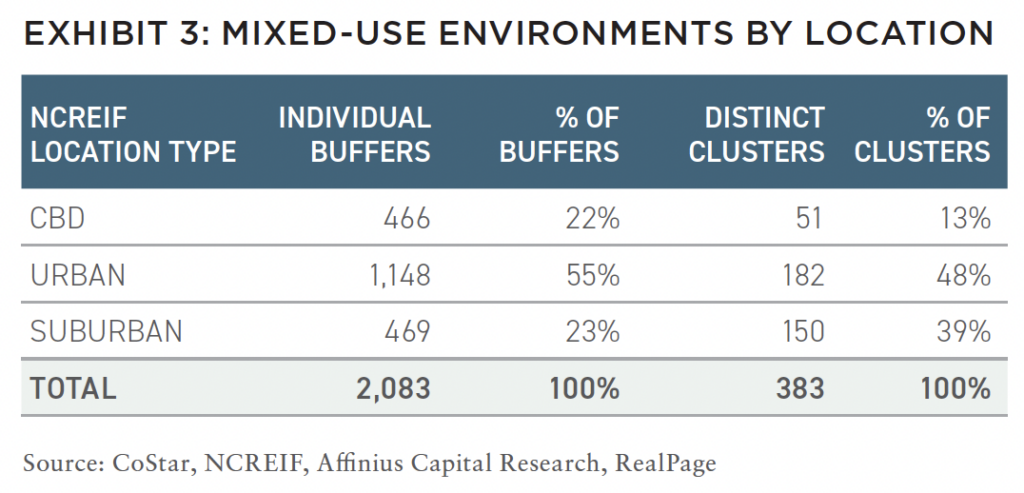
After identifying and mapping mixed-use clusters nationwide, we classified each by location using NCREIF’s industry-standard CBD, Urban, and Suburban categories.[iii] As shown in Exhibit 3, only a small percentage sit within traditional central business districts. The overwhelming majority are found elsewhere; suburban town centers, edge cities/urban nodes, and walkable suburban corridors.
What may be more surprising still to some, the premium was often strongest outside CBD areas. When we ran the within-market comparison separately within each NCREIF sector, a clear gradient emerged: modest mixed-use rent premiums in CBDs, larger in Urban locations, and largest of all in the suburbs, as shown in Exhibit 4.
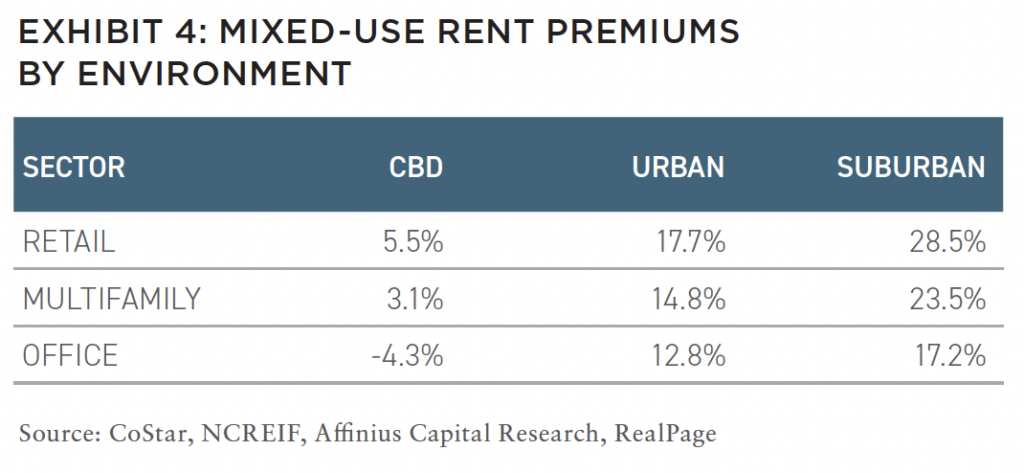
While at first glance larger mixed-use rent premiums in suburban areas may seem counterintuitive, it makes economic sense. In many downtowns, mixed-use is the default condition; office, retail, and residential co-locate densely as a matter of course, so the environment carries little scarcity value. In suburban markets, single-use development still dominates, so a genuine mixed-use node with office, retail, and multifamily in walkable proximity generally stands out sharply from its surroundings. The premium, in other words, is less an urbanity premium than a scarcity or differentiation premium: pricing power is greatest precisely where mixed-use is most distinctive.
Exhibits 5 and 6 map mixed-use clusters in Los Angeles and Dallas/Ft. Worth, with CBD/downtown clusters in orange and non-downtown clusters in green. In both metros, mixed-use environments emerge across suburban corridors, edge cities, and secondary nodes, not just the urban core.
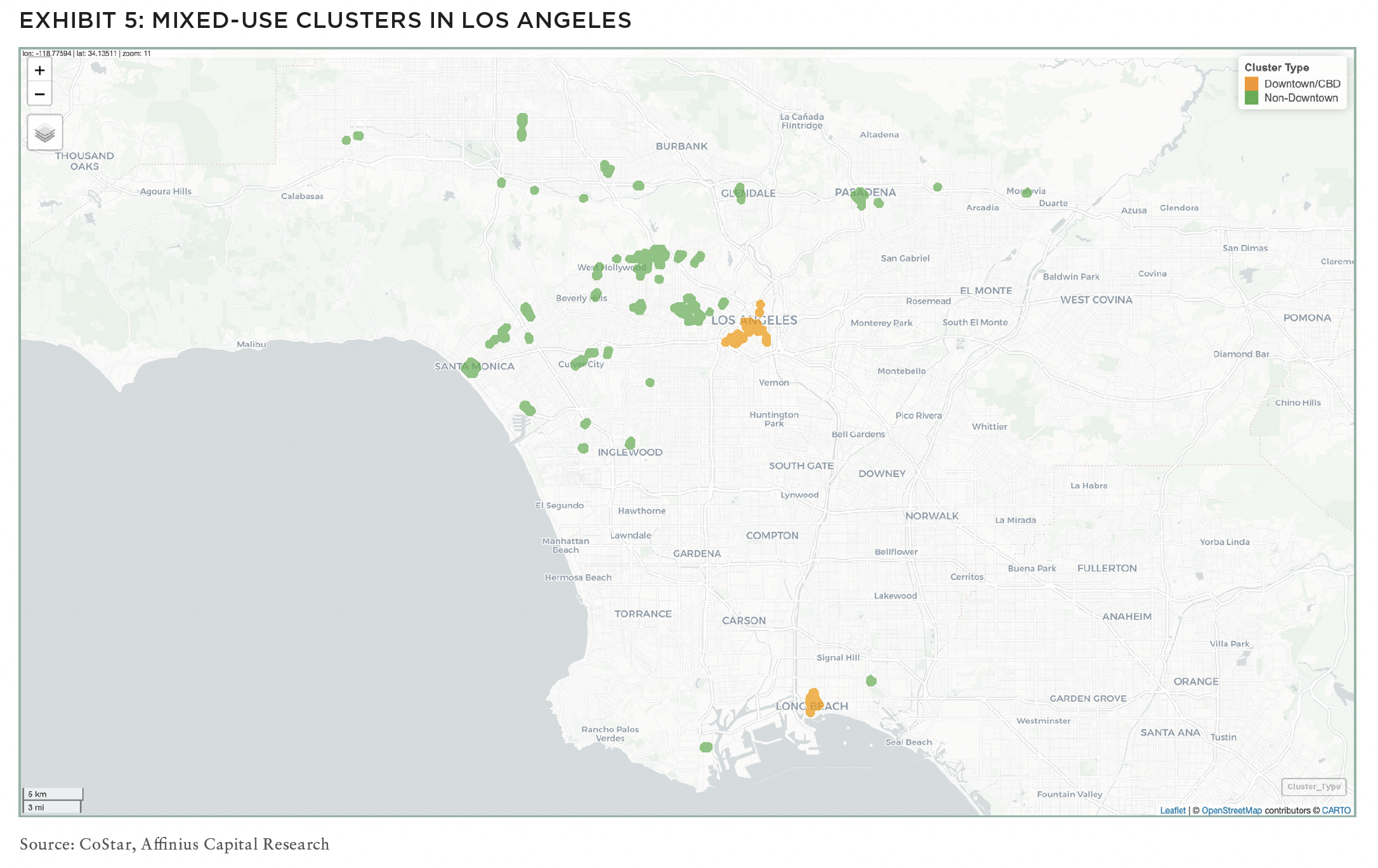
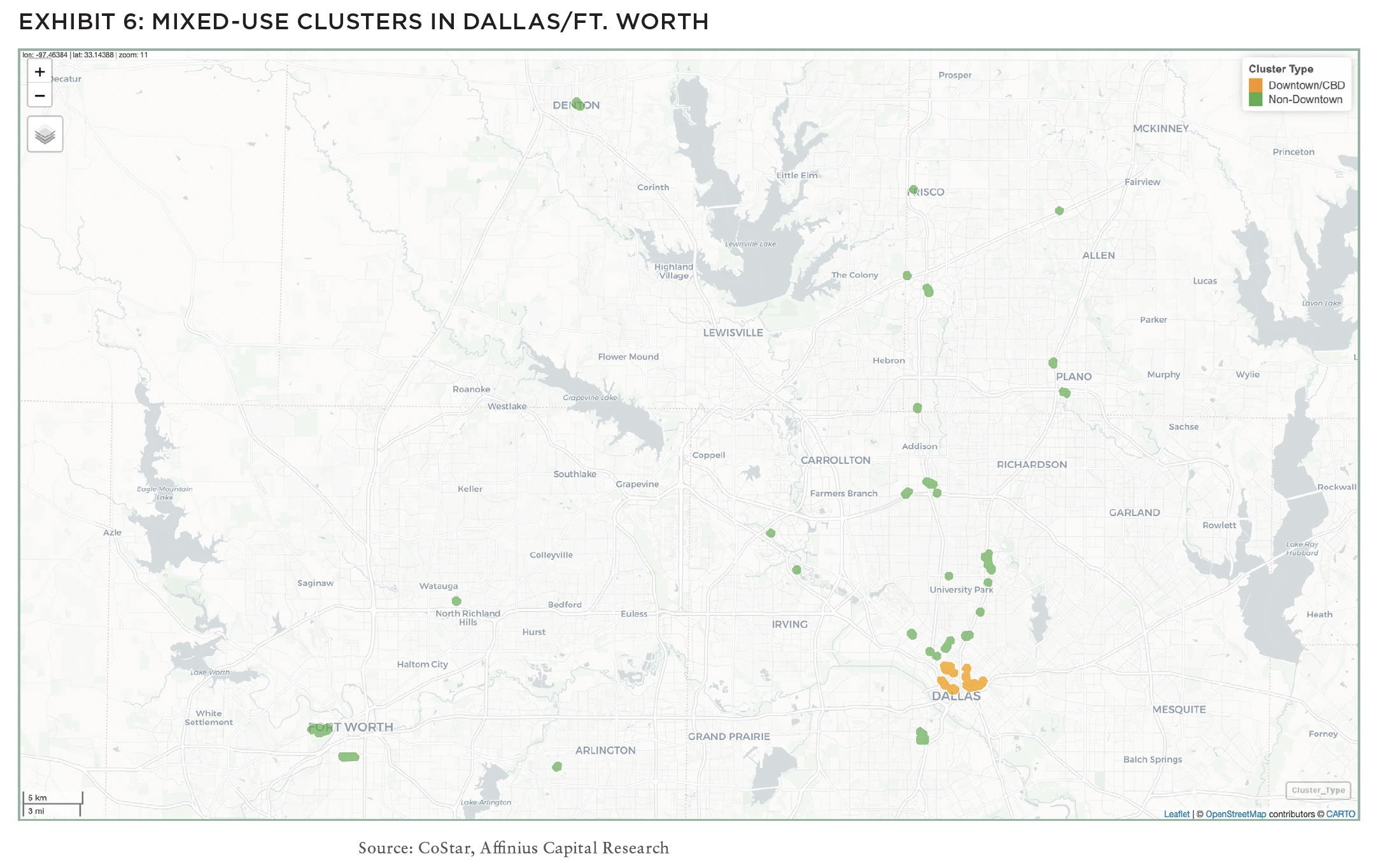
For investors, this substantially expands the opportunity set. The value of mixed-use is not confined to a handful of gateway-city downtowns; it can be thoughtfully curated in locations with the right demographics, and often at more attractive basis and yield. Our findings echo Malizia (2014), whose “suburban vibrant centers” matched or outperformed CBD office locations on key performance metrics.[iv]
None of this should be read to mean that every mixed-use project automatically creates value. In practice, mixed-use is among the most complex forms of real estate investment. Coordinating multiple property types, tenant categories, operating models, ownership structures, and capital sources introduces challenges that are largely absent in single-use projects. The same complexity that creates opportunity also creates risk.
More to the point, our analysis suggests that value is generated by mixed-use environments, not simply by stacking uses on a site plan. A residential tower above ground-floor retail does not automatically create the ecosystem effects that drive successful mixed-use districts. Density, connectivity, and critical mass matter. This helps explain why some well-designed, well-capitalized mixed-use developments underperform: retail struggles without enough residents to support daily activity; office tenants see no real benefit if surrounding amenities fail to differentiate the employee experience; public spaces sit empty if disconnected from the broader community. The uses coexist, but they do not reinforce one another.
Successful mixed-use environments behave less like collections of buildings and more like ecosystems, in which each component generates demand for the others. The challenge for investors is not merely assembling multiple uses, but creating the conditions that let those uses interact productively.
IMPLICATIONS FOR INVESTORS
Our findings suggest that mixed-use environments generate meaningful rent premiums across office, retail, and multifamily properties, providing empirical evidence that the surrounding ecosystem contributes real economic value.
Perhaps more importantly, the greatest premiums are not concentrated in traditional downtowns, but in suburban locations where thoughtfully integrated mixed-use environments remain relatively scarce and therefore more differentiated.
For investors, the implication is that mixed-use should be viewed less as a development format than as a strategy for creating complementary environments. Success is not achieved by simply assembling multiple property types on a site, but by designing the right mix of uses, scale, connectivity, and public spaces so that each reinforces the others. As investors increasingly compete on experience and placemaking rather than individual assets alone, creating these productive ecosystems may prove to be one of the most durable sources of long-term real estate value.
+ ISSUE 22

NOTE FROM THE EDITOR: ISSUE #22
AFIRE 2026 Mid-Year Pulse Survey Report (P. 6)
Market Mitigation: American Economic Power Translates into CRE Opportunity (P. 18)
Real Estate in the Next Cycle: A New Generation of Investment Ideas for the Built Environment (P. 26)
The Narrow Gate: Who Actually Raises Foreign Capital for US Real Estate (P. 36)
Middle East Institutional Capital and US Real Estate: Are They Still Friends?(P. 42)
Arbitrage in Plain Sight: How “Bucketized” Capital and Lost Skills Leave Billions on the Table (P. 52)
Real Estate Credit Reimagined: Private Credit and Debt Capital Markets (P. 60)
(Re-)Industrial Demand Drivers: From Efficiency to Resiliency (P. 66)
Zombie Funds or Patient Capital: Age Alone Cannot Distinguish a Stagnant Fund from a Disciplined Vehicle (P. 72)
Upending Underwriting: Fat Tail Risks in North American Office Investments (P. 76)
The Economics of Place: Quantifying the Mixed-Use Premium (P. 82)
The Overlooked Gateway: Opportunity Zones and Cross-Border Capital (P. 88)
Opportunities in Pro-Housing Policy Shifts: Investing in Markets with Public Policy Support (P. 94)
Rethinking Luxury Hospitality: Transforming Complexity into Long-Term Value (P. 100)
Before the Next Decision: Field Work to Organizational Capability (P. 108)
The Maturity Wall Is Already Here: Why the Headline CMBS Delinquency Rate Understat
+ ALL ARTICLES
+ ARCHIVE
+ LEADERSHIP
+ POLICIES
+ GUIDELINES
+ CONTACT
+ MEDIA KIT (PDF)
DISCLAIMER
The publisher of Summit is not engaged in providing tax, accounting, or legal advice through this publication. No content published in Summit is to be construed as a recommendation to buy or sell any asset. Some information included in Summit has been obtained from third-party sources considered to be reliable, though the publisher is not responsible for guaranteeing the accuracy of third-party information. The opinions expressed in Summit are those of its respective contributors and sources and do not necessarily reflect those of the publisher.
NOTES
[i] This entropy approach to land-use mix was pioneered by Frank & Pivo (1994) and standardized through the “3Ds” framework of Cervero & Kockelman (1997).
[ii] p < 0.001 throughout.
[iii] NCREIF location classifications (2019 Q2) assign zip codes to CBD, Urban, or Suburban based on employment density and other characteristics. NCREIF’s original four-tier scheme includes a Secondary Business District (SBD) category, which we merge into Suburban as SBD covers only 136 of NCREIF’s ~33,300 classified zip codes nationwide. We joined each mixed-use buffer to its NCREIF sector via the anchor retail property’s 5-digit zip code; all 2,083 buffers and all 383 dissolved clusters matched to a classified zip code.
[iv] Malizia, E. (2014). “Preferred Office Locations.” NAIOP Research Foundation
ABOUT THE AUTHOR
Mark Fitzgerald, CFA, CAIA, is Managing Director, Head of Research; Chenchao Zang is Senior Vice President, Research; Edmund Donaldson is Senior Managing Director, Portfolio Management; and Peter Hoberman is Managing Director, Portfolio Management, for Affinius Capital.