

A European pension fund sells its Sunbelt logistics portfolio. The withholding is wired, the certificate is filed, and the fund pays the US exactly what it expected to pay. Clean closing, efficient advisors.
Nobody at the table mentions that the gain the fund just realized qualifies for deferral, and eventually partial exclusion, under a program its investment committee wrote off years ago as domestic tax planning with no application to foreign owners.
That write-off is expensive, and it is common. Ask a non-US institution about Opportunity Zones (OZs) and the answer rarely varies: an incentive for American sellers of American assets, built around a tax foreign investors do not pay, with no bearing on how global capital enters or exits the US. The reasoning sounds airtight. The program’s benefits attach to US federal capital gains liability, and most cross-border investors have structured their affairs specifically to avoid it.
The reasoning is wrong, and it has been wrong since the program’s earliest regulations.
The error is not a technicality, either. Global investors in US real estate already pay the exit tax this program runs on, and they are deciding right now how to underwrite US property markets for the next decade while ignoring the one federal incentive built for exactly the kind of patient capital they deploy. In 2025, Congress raised the price of the mistake. It made the program permanent.
DISCOVER THE PRIZE
The existence of the Foreign Investment in Real Property Tax Act (FIRPTA) conveniently herds foreign investors toward confronting the optionality of the OZ program as a strategic tool for their follow-on private real estate investment strategies. FIRPTA exists precisely to tax foreign investors’ capital gains sourced from US real estate. Conveniently, those US-sourced realized capital gains — otherwise subject to US federal income tax — represent valid entry tickets into the program.
Every AFIRE member subject to FIRPTA and exiting US real property assets with realized capital gains has the raw materials to participate. The gateway is open, and the pathway leads to springing financial and tax benefits through the passage of time. The Treasury regulations for Section 1400Z expressly include nonresident aliens and foreign corporations as eligible participants.[i]
In the big picture, foreign investors have two taxation paths for their US real estate investment strategies: (a) FIRPTA plus reinvestment subject to an applicable tax treaty, if any; and (b) FIRPTA plus reinvestment subject to the OZ program. An investor can follow either path for different real property investments. The analytical challenge is to assess the full-cycle after-tax cash flows associated with each path under a range of long-term performance assumptions: which alternative allows the investor to keep more of the profit? More important, the program is tethered to specific geographic areas: qualified OZs. The essence of the incentive is generous financial and tax benefits in exchange for long-term equity investment in a wide range of target areas across America.
THE FRICTION, HONESTLY
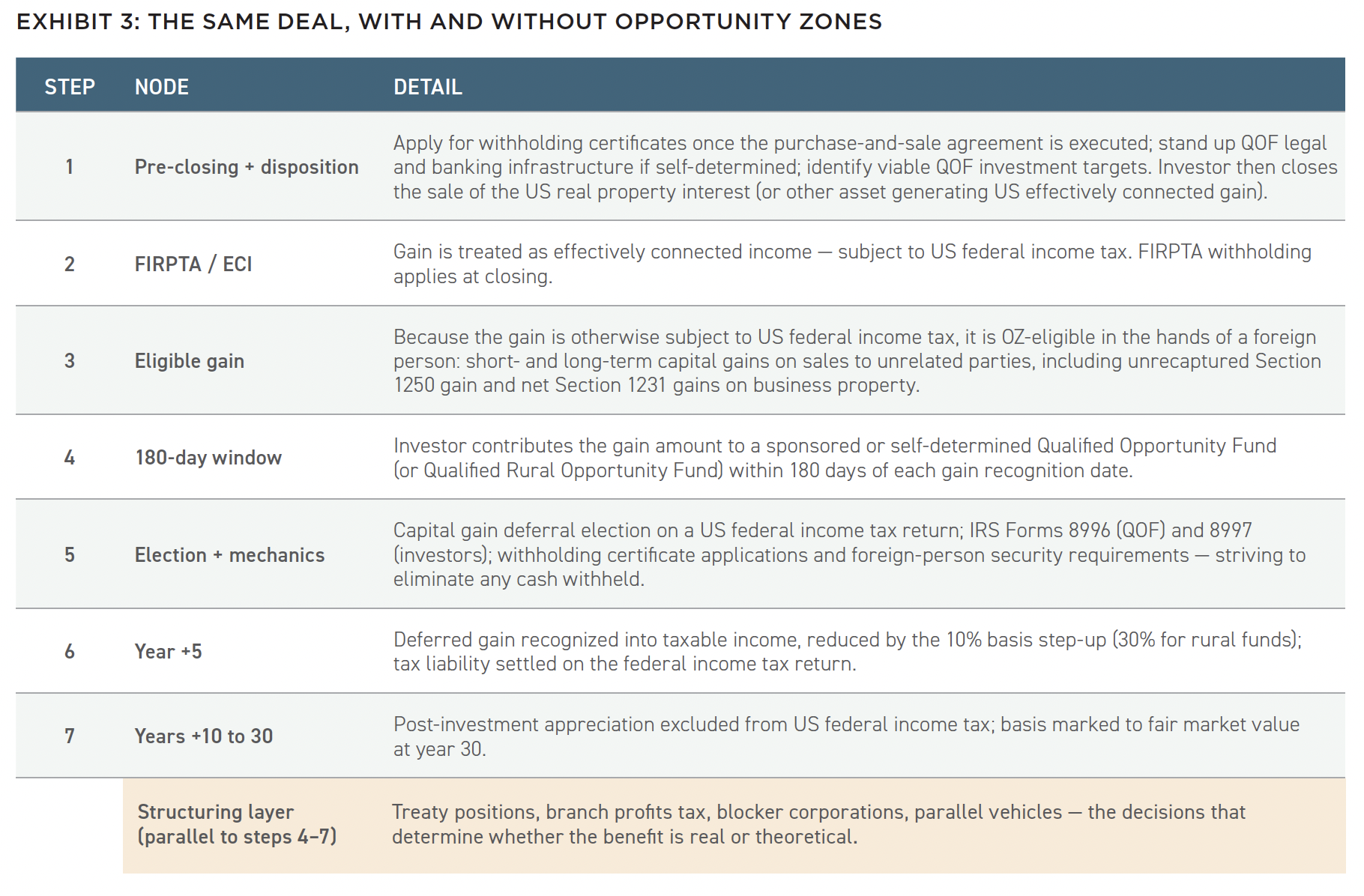
Think of the program as a special capital investment structure in which the realized capital gain that FIRPTA would otherwise tax immediately is deferred and reinvested into a Qualified Opportunity Fund (QOF)—an entity inserted between the foreign investor and the target real estate investment. Substantial flexibility is a major advantage with regard to investor controls, capitalization, and an array of real property acquisition and development or redevelopment strategies, with or without partners. A robust tax compliance regime weaves together the investors, the QOF, and the target investments.
The program accommodates the aggressive pursuit of applications for withholding certificates to minimize cash withheld at closing in the face of immediate capital gain deferral elections; the IRS may require security agreements staking a portion of the deferred gain. The investor decides the desired QOF capital structure, and compliance strategists and tax advisors build the working framework.
It is best to decide whether the program is the chosen path before harvesting real property gains, in order to glide through the various timing requirements. Most important, the program is not a side-car activity: it should be fully integrated with treasury management, tax planning, investment management, and estate planning, complete with education resources, training, and compliance programs.
WHAT CHANGED IN 2025
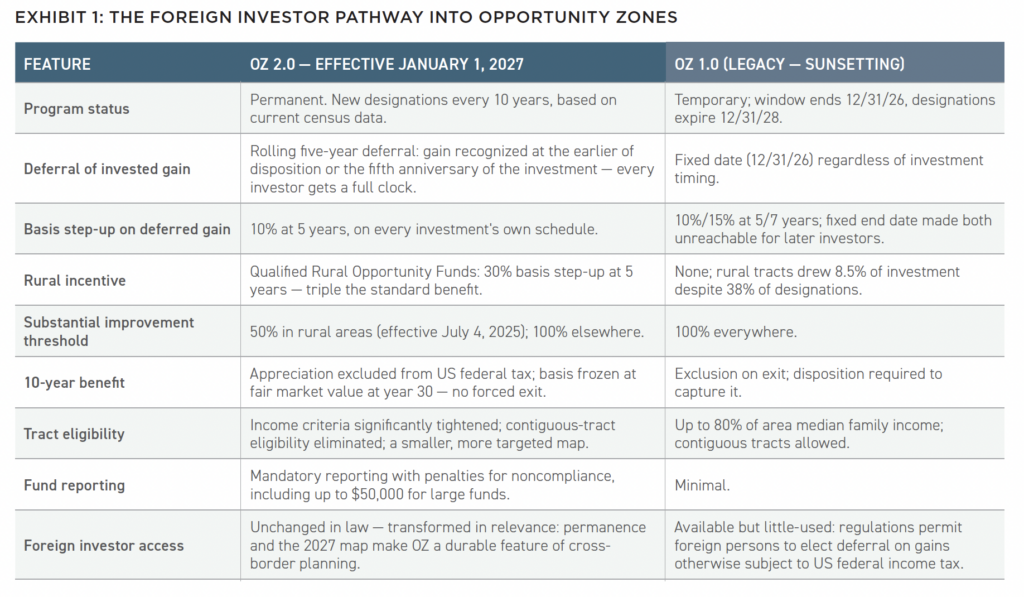
Until last year, a global allocator could be forgiven for dismissing OZs. The program was a temporary experiment with a fixed deferral date that shortchanged latecomers, a designation map frozen in 2018, and a statutory sunset that made structure-building feel like renovating a leased apartment. Congress ended the argument on July 4, 2025.[ii] The program is now permanent. Permanence, more than any single tax benefit, is what moves OZs from opportunism to infrastructure.
The tax mechanics were rebuilt to match. The fixed deferral cliff is gone. Every investment made after 2026 runs on its own clock, with the deferred gain recognized at the earlier of disposition or the fifth anniversary, less a 10% basis step-up. The economic effect is an interest-free deferral of the tax on the contributed gain. The marquee benefit still anchors the program: gains on a qualified fund interest held more than ten years exit free of US federal tax, with basis marked to fair market value at year thirty, so there is no forced sale to capture the exclusion.
Two changes matter most for institutional readers. The first is rural. Congress created the Qualified Rural Opportunity Fund, carrying a 30% basis step-up at year five, triple the standard benefit, and cut the substantial-improvement threshold for rural improved property in half, effective the day the law was signed. This is a deliberate correction. Under the original program, rural tracts made up 38% of designations and drew 8.5% of the investment.[iii] The incentives now point straight at the secondary and tertiary markets most institutional portfolios underweight.
The second is the map. Eligibility criteria are tighter and contiguous-tract eligibility is gone, which will produce a smaller and more credible map than the 2018 vintage.[iv] The machinery is running as this issue goes to print. State and territory governors are nominating tracts to the US Department of the Treasury through September 28, 2026, with every nomination treated as received when the window closes. Treasury then designates, and the new map takes effect January 1, 2027, alongside the new benefits.[v] Every ten years, the exercise repeats. The US has committed to publishing a recurring, state-curated index of where it wants capital to go. Global investors should learn to read it.
HOW TO READ THE 2027 MAP
When the designation lists publish, they will read less like a tax map and more like a market signal. A governor’s nomination slate shows where local political will, development pipeline, and committed domestic capital line up, and every state publishes one at once, free of charge. That intelligence is worth having whether or not a reader ever makes a deferral election.
Three postures follow. Allocators without US gains should treat the decennial designation cycle as an input to market selection. Designated tracts will draw a dedicated pool of domestic equity whose return requirements are structurally subsidized, which is a tailwind for surrounding submarkets and an early read on where development concentrates next.
Investors with US conviction but no eligible gains can enter the capital stack directly, lending into OZ projects or co-investing alongside qualified fund equity in designated tracts. The tax benefits belong to the QOF’s electing investors. The fundamentals—land basis, committed sponsorship, an aligned public sector—belong to everyone in the deal.
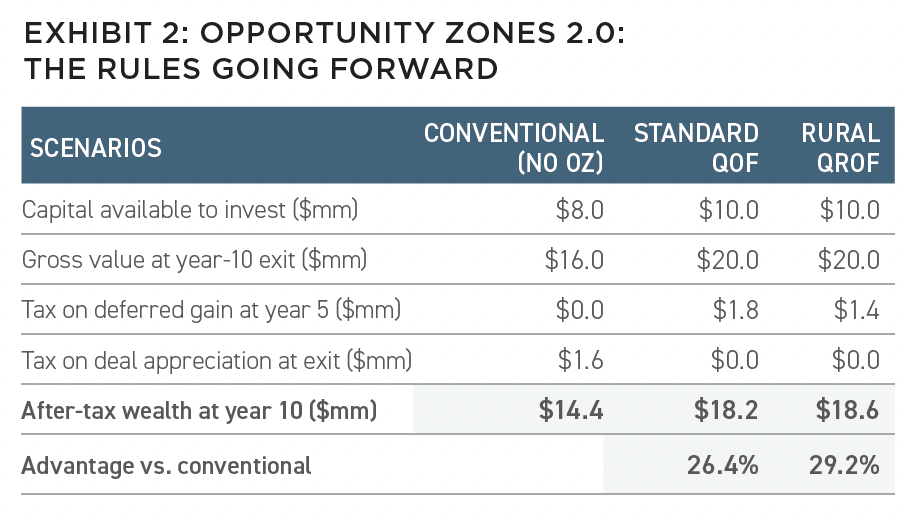
Investors holding US real property have the direct path, and they are the readers this article was written for. The gain from the next disposition is likely an eligible gain. The exhibit shows what that is worth: on an illustrative ten-year hold in which the investment doubles, the OZ path beats the conventional path by more than a quarter of terminal wealth, and by more in rural tracts. Capturing it is a sequencing question. As Section 3 makes plain, the structure has to exist before the disposition, not after.
The first program’s early movers were American family offices and entrepreneurs. The permanent program is built to institutional specifications: rolling benefits, a recurring map, mandatory transparency, and taxation clarity. The 2027 map arrives in months. The institutions underwriting US secondary markets for the coming decade should be ready to read it.
+ ISSUE 22

NOTE FROM THE EDITOR: ISSUE #22
AFIRE 2026 Mid-Year Pulse Survey Report (P. 6)
Market Mitigation: American Economic Power Translates into CRE Opportunity (P. 18)
Real Estate in the Next Cycle: A New Generation of Investment Ideas for the Built Environment (P. 26)
The Narrow Gate: Who Actually Raises Foreign Capital for US Real Estate (P. 36)
Middle East Institutional Capital and US Real Estate: Are They Still Friends?(P. 42)
Arbitrage in Plain Sight: How “Bucketized” Capital and Lost Skills Leave Billions on the Table (P. 52)
Real Estate Credit Reimagined: Private Credit and Debt Capital Markets (P. 60)
(Re-)Industrial Demand Drivers: From Efficiency to Resiliency (P. 66)
Zombie Funds or Patient Capital: Age Alone Cannot Distinguish a Stagnant Fund from a Disciplined Vehicle (P. 72)
Upending Underwriting: Fat Tail Risks in North American Office Investments (P. 76)
The Economics of Place: Quantifying the Mixed-Use Premium (P. 82)
The Overlooked Gateway: Opportunity Zones and Cross-Border Capital (P. 88)
Opportunities in Pro-Housing Policy Shifts: Investing in Markets with Public Policy Support (P. 94)
Rethinking Luxury Hospitality: Transforming Complexity into Long-Term Value (P. 100)
Before the Next Decision: Field Work to Organizational Capability (P. 108)
The Maturity Wall Is Already Here: Why the Headline CMBS Delinquency Rate Understat
+ ALL ARTICLES
+ ARCHIVE
+ LEADERSHIP
+ POLICIES
+ GUIDELINES
+ CONTACT
+ MEDIA KIT (PDF)
DISCLAIMER
The publisher of Summit is not engaged in providing tax, accounting, or legal advice through this publication. No content published in Summit is to be construed as a recommendation to buy or sell any asset. Some information included in Summit has been obtained from third-party sources considered to be reliable, though the publisher is not responsible for guaranteeing the accuracy of third-party information. The opinions expressed in Summit are those of its respective contributors and sources and do not necessarily reflect those of the publisher.
NOTES
[i] Treas. Reg. §§ 1.1400Z2(a)-1 through 1.1400Z2(f)-1 (T.D. 9889); see also REG-121095-19, 86 Fed. Reg. 19585 (April 14, 2021) (rules for deferral elections by foreign persons and foreign-owned partnerships, including security-agreement requirements).
[ii] One Big Beautiful Bill Act, Pub. L. No. 119-21 (July 4, 2025), amending I.R.C. §§ 1400Z-1, 1400Z-2.
[iii] Novogradac, “OBBBA Aims to Increase Opportunity Zones Investment in Rural Areas,” Novogradac Journal of Tax Credits (2025).
[iv] Economic Innovation Group, “Opportunity Zones 2.0: Where Things Stand After the One Big Beautiful Bill Act” (August 2025).
[v] Rev. Proc. 2026-14 (nomination procedures; all nominations treated as received at the close of the window).
ABOUT THE AUTHOR
Frances Kern Mennone is Managing Director at FBT Gibbons Industry Consultants & Advisors and a national authority on the 2026 Opportunity Zone designation process, currently advising states, municipalities, port authorities, and developers through live nomination windows. Paul Saint-Pierre, Chief Financial Officer at Pearl Bitcoin Company, is a specialist in inbound foreign investment in US Opportunity Zones. His career spans US REIT sector research, portfolio management of a global real estate securities program, and CFO roles at SEC-registered investment companies and business development companies.