

Rental housing is a large and attractive investment segment in North America that increasingly underpins local economic growth, dynamism, and demographic growth potential.
While conventional thinking has looked to supply as a positive investment constraint, the reverse can also be true, with supply constraints leading to increased risks of adverse regulatory impositions, such as rent controls, conversion restrictions, or income restrictions.
Meanwhile, communities moving toward easing barriers to new construction are enjoying affirmative population and employment in-migration, rent growth, and increased investor demand.
This article reviews key policy shift developments and how investors can update their strategies and better understand implications for their portfolios.
STATE OF HOUSING REGULATIONS IN NORTH AMERICA
While many domestic issues are extremely contentious, one area of almost universal agreement is the issue of housing affordability, which extends to both large and small cities in the United States and Canada.
To address this issue, elected officials are increasingly passing a variety of measures to counteract the problem. While even the US Congress has joined the action with the recently enacted 21st Century ROAD to Housing Act, the bulk of the action has been at the state, provincial, and local levels. These reforms are all generally aimed at increasing supply of housing—especially affordable and attainable rental housing (generally referring to rental rates that can be afford by households making up to 120% of area median income or AMI).
For real estate investors, it is important to follow these housing reforms and supportive measures as they can create investment opportunities and potentially present new risks. On the opportunity side, changes in zoning and regulatory reform can create the ability to develop or invest in new units in undersupplied markets with great demographics.
For risks, a “supply constrained” market could ultimately enact problematic regulations as demands for cost containment, unmet by new supply, lead to policies that are often undesirable to owners. Everyone should monitor and measure regulatory risks to real estate development, even if not seeking to invest in projects these reforms could create.
REPERCUSSIONS OF THE CONSTRUCTION ACTIVITY SLUMP
The longstanding regulatory crunch is now meeting unique market cycle challenges, especially in “High-Barrier Markets.” The industry has historically focused on regulatory barriers such as the impracticality of obtaining zoning changes, but must now contend with issues of construction labor shortages due to sustained periods of a building activity slump.
According to the housing advocacy organization Up for Growth, the California markets are under supplied by approximately 852 thousand units (3.78 million units nationwide).[i, ii] In response to the COVID migration, rental rate growth in the major markets of California, including San Francisco, paused and, in some cases, even fell from 2022–25. These reductions in rents along with the regulatory barriers have caused the units under construction to decline as much as 80% in the major innovation center markets of California. As of June 30, 2026, there were no remaining communities under construction in San Francisco or Oakland and there were no remaining communities in lease-up in either market. In Silicon Valley, the number of lease-ups dropped to only five communities with a total of less than 275 units available in all five remaining lease-ups[iii].
The reduction in construction activity has resulted in significant decreases in construction employment with some sub-contractors reducing their teams by as much as two thirds. Those units vacated by the construction workers (who largely left the market) have now been filled with tech workers and others seeking closer housing to their job centers. Rebuilding the level of construction talent necessary to meet the need to build new housing is going to be a challenge as the volume of new communities enter the construction phase for new development.
We have now firmly entered the new post-COVID housing cycle and the competition at each stage of the new production cycle is expected to extend these cycles upward pressure on rents for an extended period making the housing crisis greater. Thus, the need for the regulatory reforms discussed herein has never been greater.
DEVELOPMENT APPROVAL PROCESS REFORM (NEW YORK VS CALIFORNIA)
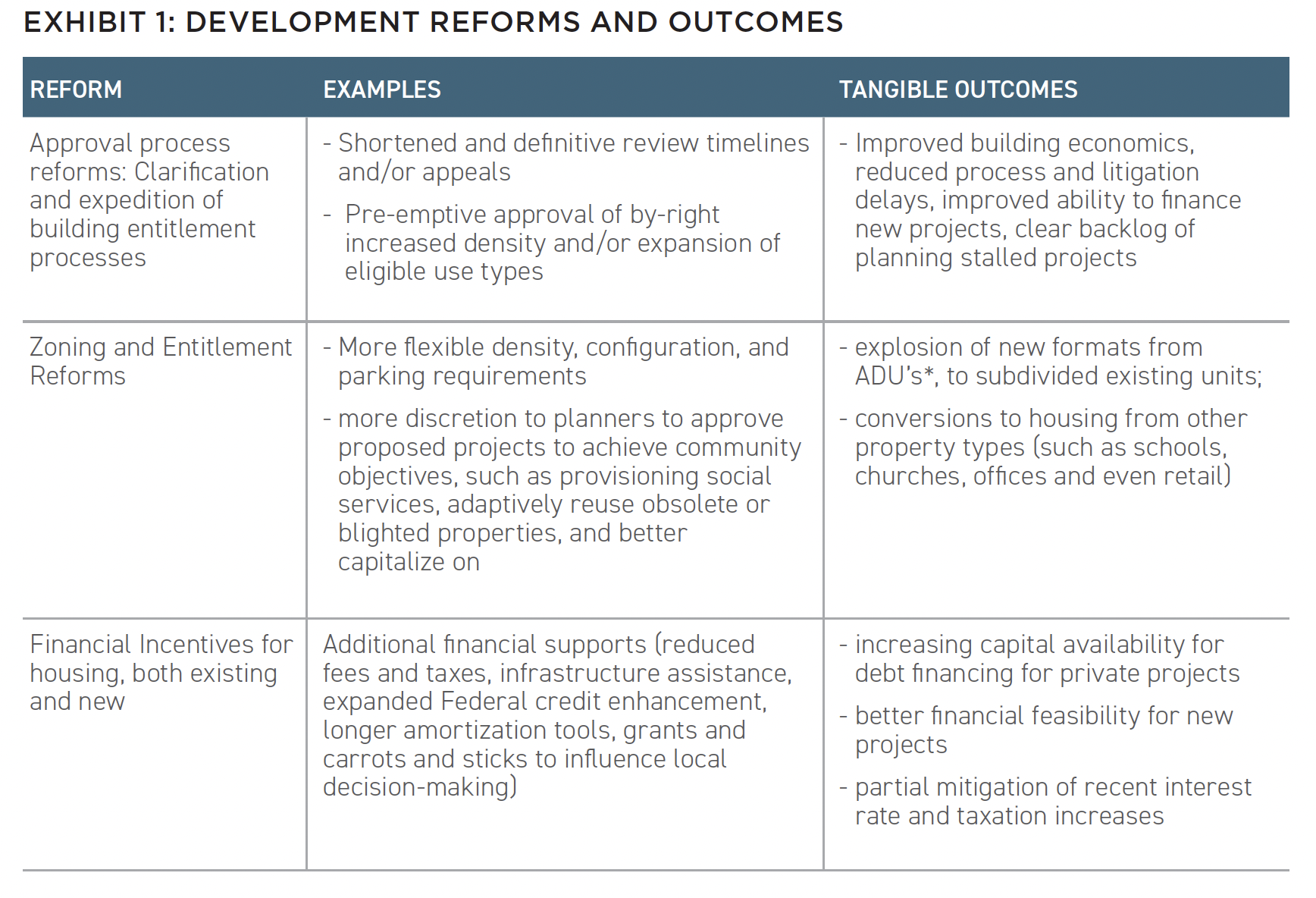
One of the most consistent elements of most of the various policy reform actions is to “cut the red tape.” Many large cities in North America “could” approve new housing projects but often take many years, with great costs to the developer, including risks of lawsuits and adverse public sentiment derailing critical votes by elected officials.
One very successful reform of this type occurred in New Rochelle, New York, a rail connected suburb approximately thirty minutes north of Manhattan. New Rochelle created a Downtown Overlay Zone around its Metro-North train station and proceeded to approve a zoning, entitlement, and permitting process that allowed developers to get a new project approved within 60-90 days of submission. The result is more than 11,000 new units authorized since its initial passage in 2015.[iv] This process combined effective upzoning with a regulatory process that streamlined many of the arduous processes and studies required in New York State, including environmental review.
This very aggressive form of policy reform was possible due to the city leadership choosing to advance project with the help of a major developer, RXR. The core part of the plan was the means by which it inhibited NIMBYs from stopping the housing developments; the pre-approvals occurred prior to actual developer plan submissions, thus the means of protesting or stopping the projects was effectively curtailed by the city’s actions. In fact, much of the development approval process reform measures are designed to combat NIMBYs and are increasingly being spurred on by the growing Yes In My Back Yard (or YIMBY) movement, which is part of the larger “Abundance” movement named after the book of the same name by Ezra Klien and Derek Thompson.
Beyond New Rochelle, many cities and states are taking a similar approach. In California, a slew of state laws has been passed, with more being proposed, to limit the ability of local municipalities to stop housing projects. The results are still tenuous, given the complex nature of the state’s regulations, though the somewhat infamous “Builder’s Remedy” (a state-level policy that forces a city to approve all housing projects if that city is otherwise failing to meet certain plans for housing growth) is already being used to get projects approved, even when public opposition is present.[v]
For investors, it is worth noting the distinction between New Rochelle and the situation in Californi. In the latter, the state is attempting to force local municipalities to comply with a set of sticks and carrots. In the former, the city itself led the effort to promote and streamline housing development by preventing state-level laws and processes from interjecting delays, as assuaged by the city’s pre-planning processes, which effectively “pre-complied” with the processes known to cause delays before developers ever submitted proposals or took financial risk. The result so far shows that the city-led examples are more successful on net, meaning investors should consider those as more “real” than statewide initiatives, all else equal.
ZONING AND ENTITLEMENT REFORMS (MINNEAPOLIS AND FLORIDA)
While the overall “red tape” to overcome can be difficult, it is often the case that the most difficult housing development hurdle is getting the actual zoning and entitlement to build new housing units. Thus, many cities and states are attempting to fix the housing undersupply by simply eliminating zoning and other entitlement requirements from housing (or at least affordable and/or attainable housing). This often eliminates the potential for NIMBY opposition to take hold in the first place and thus allows for faster overall approval without other reforms.
Minneapolis, Minnesota is becoming famous for its Minneapolis 2040 Comprehensive Plan (started in 2018) that effectively eliminated single-family exclusive zoning, upzoned land around transit, and reduced parking requirements (amongst other items). The plan went into effect in 2020 and early evidence shows success as a 45% increase in annual multifamily permit issuance has been noted in the three years since implementation compared to three years prior.[vi]
More cities are using the approach of eliminating single-family zoning or automatically allowing multifamily by-right (especially in dense, transit-connected areas) as a key tool for encouraging housing development. These include New York City, NY; Austin, TX, Charlotte, NC; and Portland, OR; and north of the border in Vancouver, Toronto and Montreal. To note, these reforms are being observed in both “blue” and “red” states and cities in the US, as well as various socialist, conservative and French-leaning governments in Canada.
Perhaps the most aggressive of these affordable/attainable housing by-right policy innovations is Florida’s Live Local Act passed in 2023. Live Local effectively acts as a preemption statute that gives an effective by-right allowance to any housing project with a 40% set aside for “affordable units” (defined as up to 120% of AMI) for 30-years.
According to The Real Deal, since its passage, there have already been 3,200 units completed with another 43,400 somewhere in the approval to development process across the state.[vii] What makes Live Local powerful is that it combines the zoning allowances with development approval process reform and even some financial incentives in certain cases. Given how unaffordable markets like Miami-Dade have become, it was passed in an overwhelmingly bi-partisan fashion despite Florida being a “red” state.
Beyond allowing for apartment complexes/towers, there are also policy reforms to allow for more duplexes, triplexes, and even ADUs. These are implicitly allowed in Minneapolis, as discussed, but also part of statewide efforts in Oregon, Vermont, Maine, Massachusetts, and Connecticut[viii], as well as Vancouver, Calgary, Toronto, and Montreal. ADUs allow for the addition or conversion of parts of what is otherwise a traditional single-family home into a separate legally rentable apartment. In theory, ADUs could substantially increase rental housing supply if built at scale.
FINANCIAL INCENTIVES FOR HOUSING
The final category of housing policy reform is direct financial incentives for projects that provide affordable and/or attainable rental housing. These can be simple reduced permitting and impact fees for housing (often contingent on affordable or attainable restrictions) or as advanced as significant cash-incentives to defer development costs (such as tax-increment financing or TIF programs or even contribution of government land to housing development projects).
Florida’s Live Local includes many of these provisions with others sporadically becoming more common across North America. Further, these state/local programs can often work in conjunction with federal programs such as the Low-Income Housing Tax Credit (LIHTC) and federal opportunity zones to amplify the overall financial incentive effect.
On the state and local level, financial incentives often rank lower in priority than the prior two issues discussed (opposite on the federal level), but the most aggressive pro-housing communities are looking to include them to stimulate housing growth.
IMPLICATIONS FOR HOUSING INVESTORS AND DEVELOPERS
Anyone allocating to any form of housing investment (existing or new construction) must be aware of these regulatory changes and know that they can appear suddenly in any market regardless of its prior political leanings or stance on housing policy. For developers, it means new opportunities in previously “closed” markets and potentially higher returns due to lower costs and faster timelines for approvals.
For owners of existing multifamily assets, it could mean reduced ability to raise rents, assuming significant amounts of new supply arrive on the market. However, these reforms have yet to prove themselves to cause any significant or even temporary states of oversupply; factors such as interest rates, construction costs, and shifts in demand are far more deterministic causes of observed localized oversupplies (such as what has occurred in Austin, Texas). Nonetheless, regulatory risk should be a factor in investment decision making now, more than ever, as this topic currently has significant bi-partisan support nearly universally in North America.
HOUSING AND ECONOMIC DEVELOPMENT
To conclude, we offer this note on the relationship between housing and economic development. Historically, real estate investments and markets have been largely viewed as being driven by jobs. Meaning, that job growth meant rising demand housing, retail, office, industrial, and all other forms of commercial real estate. Follow the jobs and good investment return will follow.
This paradigm has been shaken by the rising housing affordability issues across North America. Today, firms looking to expand or relocate operations are increasingly looking at housing affordability as a major factor of what markets to select. This point was driven home by JPMorgan CEO Jamie Dimon who noted that over the past decade, his firm shrank its New York City headcount from 30,000 to 24,000, while expanding its Texas headcount from 26,000 to 32,000 today.[ix] The point Dimon was making, and we are emphasizing, is less about people relocating from New York and California to Florida or Texas, but that marginal growth is more likely to occur where people can afford to live. Thus, it is reasonable to expect that markets that expand their housing supply will also attract more jobs, all else equal. In other words, as a real estate investor, follow the housing to follow the jobs to find the best investments.
+ ISSUE 22

NOTE FROM THE EDITOR: ISSUE #22
AFIRE 2026 Mid-Year Pulse Survey Report (P. 6)
Market Mitigation: American Economic Power Translates into CRE Opportunity (P. 18)
Real Estate in the Next Cycle: A New Generation of Investment Ideas for the Built Environment (P. 26)
The Narrow Gate: Who Actually Raises Foreign Capital for US Real Estate (P. 36)
Middle East Institutional Capital and US Real Estate: Are They Still Friends?(P. 42)
Arbitrage in Plain Sight: How “Bucketized” Capital and Lost Skills Leave Billions on the Table (P. 52)
Real Estate Credit Reimagined: Private Credit and Debt Capital Markets (P. 60)
(Re-)Industrial Demand Drivers: From Efficiency to Resiliency (P. 66)
Zombie Funds or Patient Capital: Age Alone Cannot Distinguish a Stagnant Fund from a Disciplined Vehicle (P. 72)
Upending Underwriting: Fat Tail Risks in North American Office Investments (P. 76)
The Economics of Place: Quantifying the Mixed-Use Premium (P. 82)
The Overlooked Gateway: Opportunity Zones and Cross-Border Capital (P. 88)
Opportunities in Pro-Housing Policy Shifts: Investing in Markets with Public Policy Support (P. 94)
Rethinking Luxury Hospitality: Transforming Complexity into Long-Term Value (P. 100)
Before the Next Decision: Field Work to Organizational Capability (P. 108)
The Maturity Wall Is Already Here: Why the Headline CMBS Delinquency Rate Understat
+ ALL ARTICLES
+ ARCHIVE
+ LEADERSHIP
+ POLICIES
+ GUIDELINES
+ CONTACT
+ MEDIA KIT (PDF)
DISCLAIMER
The publisher of Summit is not engaged in providing tax, accounting, or legal advice through this publication. No content published in Summit is to be construed as a recommendation to buy or sell any asset. Some information included in Summit has been obtained from third-party sources considered to be reliable, though the publisher is not responsible for guaranteeing the accuracy of third-party information. The opinions expressed in Summit are those of its respective contributors and sources and do not necessarily reflect those of the publisher.
NOTES
[i] Urbanist Peter Calthrope has stated that the entire California shortage could be build on vacant land/parking lots within ½ mile of transit, thus providing the needed housing and reducing car dependency
[ii] https://upforgrowth.org/news_insights/2025-hup/
[iii] Holland Partner Group
[iv]https://www.housingwire.com/articles/new-rochelle-predictable-zoning-housing/
[v] https://abag.ca.gov/sites/default/files/documents/2022-10/Builders-Remedy-and-Housing-Elements.pdf
[vi] https://bipartisanpolicy.org/article/comprehensive-zoning-reform-in-minneapolis-mn/
[vii] https://therealdeal.com/miami/2025/10/20/over-3k-units-finished-43k-in-pipeline-under-live-local-act/
[viii] https://www.pew.org/en/research-and-analysis/articles/2025/09/15/state-legislatures-make-bipartisan-breakthroughs-on-policies-that-promote-housing
[ix] https://fortune.com/2026/04/08/jamie-dimon-shareholder-letter-high-taxes-new-york-exodus-edge-over-miami-top-talent/
ABOUT THE AUTHOR
Amy Erixon is Principal and President, Global Investment Management, for Avison Young Investment Management. Joshua Harris is a Managing Partner for Lakemont Group, a boutique real estate and economic consultancy; and an adjunct professor of real estate at Fordham University. Clyde Holland is CEO and Chairman of Holland Partner Group.